Thursday, September 30, 2010

Reaction to "How should a user experience designer be used?"

A new blog post by Jason Buck, a contributing writer for Econsultancy, discusses misconceptions and general perversions of the role of "User Experience Designer." In general, I am in agreement with the points made in the post. I agree that a good User Experience Designer must be a champion of end-user needs, not just a Designer (although, one could argue that inherent in "Good Design" is an understanding of end-user needs). In order for the professional UXD to defend end-user requirements, he/she must be skilled at gathering and documenting them. These requirements, ideally, are gathered as a result of end-user research, which the UXD should be able to design, facilitate, and analyze. In addition, as a conceptual thinker and visual communicator, he/she must translate these findings into intuitive and compelling interfaces for applications and marketing experiences.

It is over the importance of the wireframe, the visual expression of the information prioritization developed as a result of end-user discovery, that my point-of-view differs slightly from Jason's. Let me explain.

As described above, it is clear that a User Experience Designer needs to be more than a "glorified wireframer."  That being said, I think I detect some minimization of the role of "Interaction Designer" by the use of the label "glorified wireframer." Great Interaction Designers facilitate the completion of business objectives as well as key end-user tasks by understanding the research, personas, and behavioral trends uncovered through contact with end-users. It is a pet peeve of mine, to listen to a Usability Professional, such as an Information Architect, boast that he/she has moved beyond "cranking out wireframes," to do something more noble (e.g. - Taxonomy development). Research, conceptualization of the experience, as well as detailed interface design is all integral to User Experience Design. One end of the UCD spectrum is no more important than the other. In other words, the richest end-user insights can be "lost in translation" (poor Interaction Design). That, however, may be Jason's point exactly.

Jason also states that the fact that he is "increasingly contracted out by agencies, with no brief and little or no access to the end client" as a "troubling development." As a business owner and a manager, I'll be very honest in stating that I require reassurance that my contract User Experience Designer is a seasoned consultant, prior to me exposing him/her to clients and end-users. The contractor interview process is too brief for me to gain that confidence, so I need to rely on trusted referrals or my own instincts about the candidate. That being said, I may hire a contractor just because he/she is a skilled Interaction Designer. If that is the case, end-user requirements will be provided to the Interaction Designer. Additionally, the ID will be debriefed by the Usability Professional who conducted the end-user research.

Jason goes on to say that "anyone can draw wireframes" and that he's "seen Project and Account Managers producing nicely laid out wireframes that, to the client at least, look no different from the ones produced by that pesky extra UXD resource they don’t want to pay for any more." I've always maintained that Usability Professionals such as Interaction Designers and Information Architects must be able to show how Design decisions achieve business and user objectives. This rationale and context must be provided along with the wireframe. Additionally, the decisions made to achieve these objectives must be measurable. Only skilled practitioners can follow the guidelines above, so the statement "anyone can draw wireframes" is problematic for me.

I agree with Jason's final point that UXDs should be brought into the project lifecycle at an early stage. I would go further, however, to suggest that Visual Design, Copy, and Technology should also be brought into the project lifecycle at an early stage.

Monday, September 27, 2010

Develop a Research Plan Using Mindjet MindManager

Mindjet MindManager is intuitive mind-mapping software that can also be used to generate project documentation in Microsoft Word. I use MindManager for research documentation and client project proposals.The following describes all of the necessary elements for a solid qualitative, behavioral research plan. That plan can be easily generated by creating a mind map using Mindjet MindManager.

To begin, open the MindManager application to create an outline for the research plan. Create a new map, and you'll end up with a single "topic shape" in the center. Rename the topic shape, "Client Lorem Research Plan" (replace "Client Lorem" with the client's actual name).


Continue by adding six sub-topics. Select topic shape, "Client Lorem Research Plan," and hit the "Enter" key six times. The result should end up looking like the screenshot below.


Rename the newly created sub-topics in the following order: Summary, Objectives, Population, Methodology, Analysis, and Next Steps.


Select the "Methodology" sub-topic, and hit the "Insert" key. Next, hit the "Enter" key three additional times. Rename the four sub-topics of "Methodology" to: Recruiting Participants, Screening Participants, Interviewing Participants, and Equipment/Technology.


Next, select the "Analysis" sub-topic, and create three sub-topics in the same manner as the newly created sub-topics of  "Methodology." Rename these sub-topics, Findings, Personas, and Mental Models. The finished outline should look like the screenshot below.

To generate the Microsoft Word version of the research plan outline, select the MindManager button from the application main menu (top), and then select "Export > Export to Microsoft Word."

After a prompt to save your file, you'll see a dialog box entitled, "Microsoft Word Export Settings." Change Microsoft Word settings be selecting options in the dropdown menus according to the screenshot below.

The result will be a Microsoft Word document that is a perfectly formatted outline for a research plan. Complete the research plan by adding appropriate detail to the topics described in the outline. Adding detail can be done in MindManager or Microsoft Word. The following describes the type of content that is needed for each section of the research plan: 

1. Summary- Briefly describe the research study. The summary should include any hypotheses, formed as a result of previous research, that the study will seek to validate. One of the objectives of the new research study should be to fill gaps in knowledge about the target audience. 

2. Objectives- Outline the goals of the research. Describe how the research objectives support the overall business objectives. Explain how uncovering the informational needs and key behaviors of users will ultimately satisfy business objectives.  

3. Population- Identify the desired user segments for the study. Describe and justify the sample size for each segment. Remember that the initial research population should reflect the demographic targeting of the business. The goal for the research, however, will be to group users by their key behavioral differences, resulting in behavioral personas. 

4. Methodology- Describe every aspect of the end-user research study. The methodology should provide exhaustive detail about the following research tasks:
  • Recruitment- Document the method for identifying and scheduling research participants. Here, you will need to mention any recruitment partners or online services, such as Google AdWords, used to identify candidates for the study. Recruitment is often handled by the client, especially if they have easier access to their audience, customers, or end-users.

  • Screening- If targeting multiple user segments for the study, explain how these segments will be recruited and tagged. List questions that will be asked, either by phone or electronic screener, to evaluate candidates for the study.
  • Interviews- It is of utmost importance to describe the flow, line-of-questioning, and environment for the research interview. Provide a rationale as to why the particular technique of choice was selected for the research study. To aid understanding, add a visualization or information graphic to illustrate the sequence/flow of the research interview.

  • Honoraria- Provide detail about the incentive for the study.

  • Equipment/Technology- Identify any audio/video equipment used to record the interviews, or software used to capture facial expressions and mouse clicks.
5. Analysis- Make it clear to the client how the research findings will be developed, documented, and utilized to inform the Information Architecture.
  • High-Level Findings- Describe how the research analysis will yield high-level behavioral trends that may be true of many, or all, behavioral segments.
  • Personas- Discuss the importance of aggregating findings by key behavioral differences, resulting in "behavioral personas." Personas will contain a brief description of the segment, as well as their key motivations, tasks, and behaviors.
  • Mental Models- In this section, provide the client with a definition and description of the mental models that will be elevated in the research findings. Mental models are a visualization of the key tasks of each behavioral segment, accompanied with an identification of the type of content needed to satisfy each key task.
 6. Next Steps- Make it easy for the client to understand what is needed in order to begin the research study. Next steps may include a simple Gantt Chart that illustrates a proposed timeline for the study as well as any requirements or information needed to begin the work.

Research plans may vary according to the particulars of various client initiatives, but making sure the above topics are covered will ensure that  the client is educated and understands the value of the research that they are being asked to pay for.

Wednesday, September 15, 2010

Use Social Media to Drive Brand Engagement

Savvy marketers are using social media to create brand awareness, not through hype, but by delivering relevant content and services to target audiences. Really, "social marketing" is nothing more than a content strategy. As such, relevance is key. Delivering relevant content to target audiences requires research and planning:

1. Define target segments based on their social roles/behavior - Identifying audience segments for a social media strategy is a different process than segmentation for a traditional marketing strategy. Social media segmentation is based on distinct behaviors across social media channels. Each individual, within a single "social graph," behaves differently, and is of unique value to marketers. At the base of the pyramid (meaning there are more of them) are those who do not actively engage in social media beyond consuming and sharing relevant content with their connections. Even though they are less likely to engage in conversations, they aggregate and surface relevant content to individuals who are more likely to engage with the content. For these individuals, content must be relevant, and businesses should provide them access to share content with their social connections. The middle of the pyramid contains individuals who sometimes engage in conversations and generally participate in social media. For these individuals, it is not only important to provide relevant content, but also to introduce topics that are likely to be discussed. The top of the pyramid contains a minority of individuals within a social graph who are the most vocal and have the most influence within their social network. It is of extreme importance for businesses to be relevant to these individuals, reach out to them directly, and empower them, because they have the greatest ability to evangelize the business and brand publicly.

2. Audit existing content to determine relevancy and portability - To regularly generate valuable and relevant content to consumers is a huge responsibility. It requires referring back to existing marketing segmentation studies to determine the type of content that resonates with personas. The process then entails making a determination about whether or not to produce fresh content or identifying existing content that can be extracted, made portable, and shared across social networks. Prior to investing time, money, and resources developing new content, businesses may already have access to valuable content that can be shared gradually. Identify pieces of "micro-content" that can be drip-fed into relevant social media channels. Such content includes: information graphics, articles, demos, etc.

3. Monitor brand awareness, reach, and influence in social media - Marketing goals vary with different social media strategies, however, there are established metrics to measure the awareness, reach, and influence of business brands across social media channels. Use web sites such as "Social Mention" to monitor key performance indicators for social media campaigns. The most important to monitor are strength, sentiment, passion, and reach. Strength is the likelihood that a brand is being discussed in social media. Sentiment is the ratio of positive mentions in social media vs. negative mentions. Passion is the likelihood that people who mention a brand in social media will do so again. Reach is the measure of a brand's influence.

4. Provide continuous support for social media campaigns/tactics - Participation in social media requires constant updates, continuous support, and dedication. Social media is a commitment to maintain an ongoing conversation with customers. As such, there should be dedicated resources who carry on this conversation and regularly respond to issues. Long periods of silence or delivery of irrelevant content will be noticed by followers of the brand.

5. Be personal - As social media is largely a conversation, assign actual people to engage in conversations with customers. Nobody wants to have a conversation with a "brand," unless you are Apple or Nike. Even then, the brand is more credible when there are actual people who represent them. Use real people, and their photographs, when blogging and micro-blogging.

Jonathan Lupo
@userexperience (Twitter)

Monday, September 13, 2010

Essential Communication Skills for Information Architects

Information Architects need to be strong communicators to be able to organize, conceptualize, and present information to project teams, clients, and end-users. The skills needed, however, vary greatly from one project phase to another. The following are vital communication skills for Information Architects to possess, as they move through project phases.

Phase 1: Discovery

1. Inquiry/Investigation - The first order of business for any initiative is to identify and document goals and objectives. During a project discovery phase, Information Architects are required to play the role of lead investigator, as they conduct research to assess the needs of both clients and end-users. As investigators, IAs develop lines-of-questioning that are skillfully aimed to uncover vital insights to achieving project objectives. Facilitating and maintaining the flow of a conversation, as well as asking skillful questions, is necessary in order to gather rich insights during interviews.

2. Cognition/Evaluation - Wikipedia defines "cognition" as the "process of thought." After collecting business objectives from client stakeholders, data from previous research studies, and data from newly conducted research studies, Information Architects have the daunting task of analyzing this mountain of data. This evaluation involves the identification of trends that can be used to conceive conceptual models for information and user behavior. Information Architects process information by collecting data, and then identifying and documenting data trends.

3. Conceptualization - Once information has been organized and documented, IAs develop mental models, process flows, and information graphics to attach meaning to information and data trends.
  • Mental models aggregate the trends in end-user tasks that have been collected as a result of behavioral research. It is the goal of the Information Architect to facilitate the completion of these tasks with a planned information architecture for a web site or application.
  • Process flows are extremely important tools for Information Architects to visually document and communicate sequential processes. Process flows are especially important when collaborating with developers, who need to build the underlying infrastructure to support a key, end-user process.
  • Information graphics use graphic elements and charts to visually communicate complex informational concepts and data trends. They are useful in presenting concepts in a summary or abstract manner.
4. Verbal Communication/Presentation - Research findings, once documented, need to be presented and accepted by internal and external teams. Excellent presentation skills are needed to develop a compelling narrative framework for research findings and proposed concepts. During this phase, Information Architects face the challenge of presenting their "proposal" to various stakeholders with different agendas. For business stakeholders, Information Architects must present their proposal within the context of business requirements and objectives, otherwise the presentation will not resonate with the audience. For project managers, designers, and developers, the Information Architect must quickly illustrate how findings lead to Design recommendations that can be put on a time-line and quantified in terms of "level of effort."

Phase 2: Design

5. Negotiation/Persuasion - It typically takes a series of presentations, delivered to various sets of stakeholders, for an Information Architect to make a convincing case for a business to change how it communicates to its customers. Educating a client requires fine-tuning and adjustments to the presentation to accommodate each key stakeholder's agenda. The IA may face challenges when his/her methodology is called into question. If this is the case, the presentation may need to amplify a rationale for the decision to limit the sample size of the research population (for example). It is important to remember that, as an Information Architect, the informational needs of the audience for the presentation should be considered and accommodated. Addressing the audience's informational needs directly will elevate the credibility and persuasiveness of the presentation.

6. Organization - The process of organization entails taking a large amount of information, placing it into high and low level groupings, and then prioritizing the groupings as well as the information contained within each group. If the Information Architect is given the "green-light" to proceed with tactical recommendations, he/she must create an organizational model for content that exists to satisfy the needs of end-users. The mental model, which aggregates expected end-user key tasks, should be leveraged to conceive the organizational scheme for the application or web site (documented in the form of a site map).

7. Visual Communication/Information Design - Described above, is the process to develop a high-level, information organizational model for an application or web site. It takes an entirely different skill, however, for Information Architects to establish information relationships at a low-level, by defining information relationships and interactions on a screen-by-screen basis.  Information and Interaction Design is a subset of an Information Architect's total set of skills.

8. Collaboration - There isn't a single solution to every Design challenge. Therefore, great Information Architects understand that Design is improved with insights gathered from a team of talented professionals. Being collaborative requires Information Architects to have an open-mind, and proactively solicit alternative design patterns that successfully accommodate the needs of end-users. Selecting the right solution from many proposals covers a wider range of options than relying on a single source for recommendations.

Jonathan Lupo
@userexperience (Twitter)

Thursday, September 09, 2010

How to plan for a successful project kick-off

A successful project kick-off can build the foundation for a healthy client relationship as well as provide an agency team with most of the necessary information to be successful on a project. Success requires leadership, coordination, and collaboration amongst team members. Lack of preparation can result in a bad beginning to a project, and diminish the credibility of the individuals who are likely to be the key players on the project team.
1. Plan the agenda weeks in advance - Early prepartion is key to ensure proper attendance to the kick-off (both internal and external team members) and to ensure that vital information and documentation is delivered to the agency team for review. At minimum, a statement of work or proposed project approach should be available for both the client and agency to review and agree upon during the kick-off.  It is better to have an accompanying presentation that shows the client that the team has already begun work.
2. "Socialize" the agenda with both internal and external stakeholders - Make sure that each individual on the project team understands his/her role and responsibilities during the kick-off (as well as the project). Send early drafts of the agenda to the team to ensure that the document is read and that each individual understands his/her responsibilities with respect to presenting each agenda item. Having multiple authors on the agenda (and accompanying presentations) also increases each team member's sense of ownership and commitment to the project.

3. Visualize complex processes and timelines - Nothing is worse than a dense project plan or timeline that is crammed onto a PowerPoint slide and barely legible when projected in a large conference room with many attendees. Tailor presentation content to the needs of the audience and to the presentation technology. Create executive summaries of complex information and visualize processes and workflows. Information graphics work better than slides and slides of bullet points in PowerPoint. Tell a story with graphical representations of information.
 
4. Plan for break out sessions - Project kick-off meetings tend to be crowded, as everyone who has been identified as a stakeholder, partner, or agency resource, is introduced. While it is important to have a large attendance for introductions, to get the team on the same page with respect to project objectives, and to create an enthusiastic and energetic atmosphere, the real work should happen in smaller teams. Include these smaller breakout sessions as part of the agenda and identify which team members are appropriate for each sub-team meeting. The goal for sub-team meetings should be to define requirements with sub-team stakeholders and next steps for various project work streams. 
5. Come prepared with insights about the client's business - Weeks before the kick-off, the project team should be reading news articles and journals related to the client's industry. Being up-to-date with trends and having a contemporary understanding of a client's business is vital to establishing credibility and confidence. Additionally, early research enables the team to begin to examine the project road-map and identify overlooked opportunities for the client to innovate and differentiate from competitors.
Jonathan Lupo
@userexperience (Twitter)

Monday, September 06, 2010

How to create a predictive search prototype in Axure

Axure is a great application to use when mocking up interaction design concepts for usability testing. I have recently used it to simulate the interaction and display of  predictive search results activated when a user enters a specific keyword query into the search textfield. The following is a step-by-step tutorial for mocking-up an interactive "predictive search" prototype using Axure. It assumes a basic familiarity with the Axure application interface.

1. Set up your workspace- After opening the application, make sure that the "widget" panel (upper-left), the "masters" panel (lower-left), the "annotations & interactions" panel (upper-right), and the "dynamic panel manager" are all visible in your Axure workspace.


If any of the four panels above are hidden, open the "View" sub-menu from the application main menu and make sure each of the panels are checked in the menu.


2. Add a "New Master" - Create a new master by clicking on the "Add Master" icon in the "Masters" panel (lower-left). Double-click the label of the newly created master, called "New Master 1," to open the "New Master 1" tab in the "Wireframe Pane."


3. Create the search interface - (In the "New Master" tab) Drag the "Text Field" and "Button" widgets into the "Wireframe Pane".


4. Label the interface elements - Select the text field and give it a label in the "Annotations & Interactions" panel (upper-right). A label such as "search_textfield" will do nicely.


Select and label the search button. I labeled mine "search_button."


5. Add a "dynamic panel" - Drag the dynamic panel widget from the "Widgets" panel to the "Wireframe Pane." Re-size and place the panel underneath the search text field.


Set the dynamic panel to "hidden" by right-clicking the mouse while the panel is selected in the main
wireframe panel.


The dynamic panel, once set to "hidden," will appear yellow.


6. Label the dynamic panel - While the yellow dynamic panel is selected, give it a label in the "annotations & interactions" panel (as you did for the search textfield and button). I called mine, "predictive_layer."


7. Create the predictive search drop-down layer - Double-clicking the yellow, dynamic layer, will produce the "Dynamic Panel State Manager" dialogue box. You'll need to create a state for each predictive search result you want to mock-up. By default, one state already exists in the dialogue box. That state is labeled, "State 1." Although you'll probably want to change that label at some point, let's continue.


To create a mock predictive search layer that displays when a user types a specific string of characters, make sure that the panel state, "State 1," is selected. Next, click the "edit state" button on the right. You'll end-up viewing the workspace within a tab labeled, "State 1."


8. Mock-up the first predictive search result - You can visually style your search result drop-down menu however you want to (as long as it is contained within the blue guidelines in the "State 1" tab. For speed's sake, drag a white rectangle widget and a "text panel" widget from the "Widgets" panel into the "wireframe pane (center stage)." Make sure both widgets sit within the blue guidelines, which represent the viewable area that of the search drop-down layer. In addition, make sure the text panel sits on top of the white rectangle. Edit the text of the text panel to represent the predictive search results that you want displayed in reaction to a specific query. My scenario has to do with music, so I have created a drop-down list of musical artists that will display when the user types the search term "green."


9. Create the interaction that will trigger the predictive drop-down layer - Select the "New Master 1" tab in the center "Wireframe Panel," so that you can attach a behavior to the search text field. Select the text field and double-click on the "On KeyUp" interaction in the "Annotations & Interactions" panel. A dialogue box labeled, "Interaction Case Properties" will appear.


In the "Step 2. Select an Action" list that is displayed within the "Interaction Case Properties" dialogue box, select the "Show Panel" action. Next, select the blue hyperlink labeled, "Show Panel" in the "Step 3 - Edit the Actions" panel below.


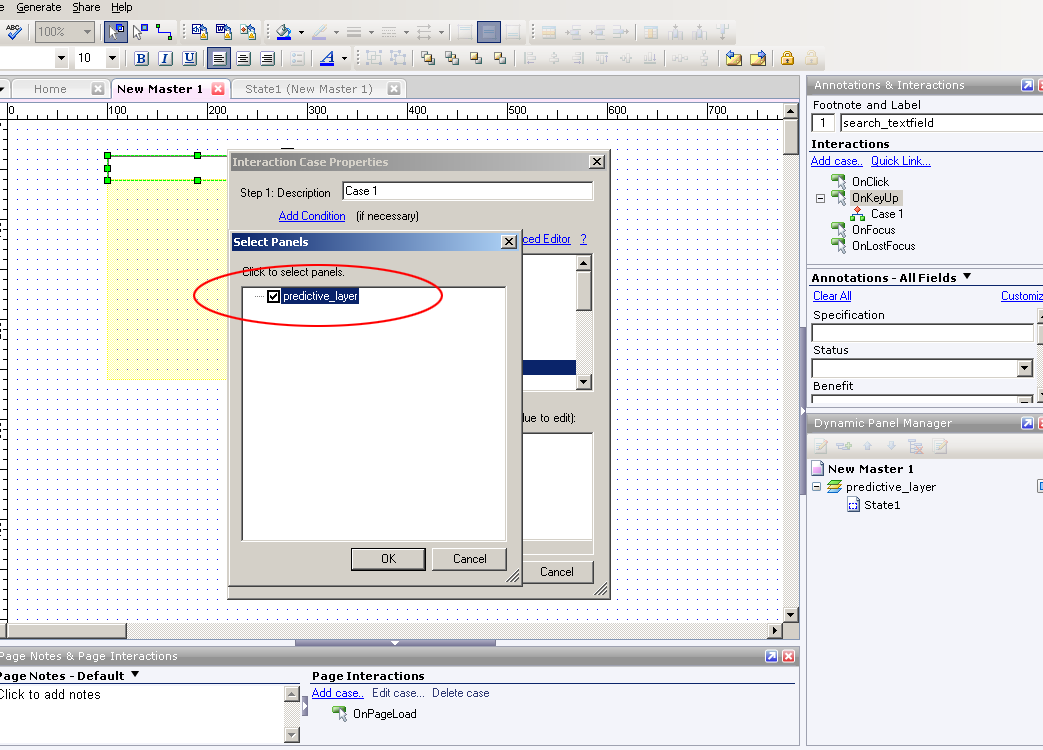
Clicking "Show Panel," will produce a second dialogue box prompting you to select the panel to display. Since only one panel was created, select the "predictive_layer" panel from within the dialogue box. Click the "Ok" button.


The second dialogue box will disappear and the 1st dialogue box will remain visible. Next, you'll need to create the condition that will produce the "predictive_layer." Do so by selecting the "Add Condition" hyperlink at the top of this dialogue box.


The dialogue box that appears when you select the "Add Condition" hyperlink above, is labeled the
"Condition Builder." In it, you'll need to make sure that the series of drop-down menus have the following values selected:

1. Satisfy "All" conditions (1st drop-down menu)
2. "text on widget" (2nd drop-down menu)
3. "search_textfield" (3rd drop-down menu)
4. "equals" (4th drop-down menu)
5. "value" (5th drop-down menu)
6. Next, type the word "green" in the text field adjacent to the 5th drop-down menu

All selections, if made correctly, will look like the following screen shot. When finished, click the "Ok" button.


The "Condition Builder" dialogue box will disappear. Finally, click the "Ok" button on the "Interaction Case Properties" dialogue box. You are now ready to test your first predictive search result.

10. Apply "Master 1" to all pages -If you are planning to mock-up multiple pages that contain the search interface, you must apply the master that contains the search interface ("Master 1") to those pages. Do so by right-clicking on the "Master 1" label in the "Masters" panel (lower-left), and then selecting "Add to Pages" in the resulting menu.


The resulting dialogue box will prompt you to select the pages in your Axure prototype to which you want "Master 1" applied. Select as many of the pages as you want. For the purpose of this demo, I selected all pages (using the "Check All" button on the right). For testing purposes, make sure you at least select the "home" page. When you are finished, click the "Ok" button.


11. Generate a prototype to test your 1st predictive search interaction - Generate a prototype by selecting "Generate" from the main application menu (top) and then selecting "prototype" from the resulting sub-menu.


The resulting dialogue box will require you to select a destination for the prototype on your hard drive.


Once you have selected a destination on your hard drive for the prototype, finish by clicking the "Generate" button on the bottom of the dialogue box. Your prototype should open in your computer's default browser. You'll see two frames (columns). The left frame contains a tree-navigation/hierarchy of the pages in your Axure project. Clicking any of the links will enable you to navigate to each page in your prototype. The center frame contains your search interface. By default, you'll start from the "Home" page.

12. Enter the search term "green" to test your prototype - To test the first predictive search layer, simply type the word "green" into the search textfield. If you have followed all of the instructions correctly, your drop-down menu should appear beneath the search interface as shown below.

Hopefully, your layer activated after typing the word "green" into the search box. To mock-up another predictive search use case, return to the Axure application window. Make sure you are working in the "New Master" tab. Double-click on the yellow, dynamic panel labeled "predictive_layer" to produce the "Dynamic Panel State Manager" dialogue box. You'll need to create an additional state for a second predictive search result that you want to mock-up. You'll see "State 1" in the list. To create another state, type a name for the new state in the textfield that is labeled "Add a new state." Now, click the button labeled "Add." I named my new state, "State 2."


After clicking the "Add" button, you'll notice a second state, "State 2" has been added to the "Panel State" list.


Double-click on the newly created "State 2" to open up a tab that has the same label. You will now create the design of the second search result layer.

13. Mock-up the second predictive search result - Again, you can visually style your search result drop-down menu however you want to (as long as it is contained within the blue guidelines in the "State 1" tab. For speed's sake, drag a white rectangle widget and a "text panel" widget from the "Widgets" panel into the "wireframe pane (center stage)." Make sure both widgets sit within the blue guidelines, which represent the viewable area that of the search drop-down layer. In addition, make sure the text panel sits on top of the white rectangle. Edit the text of the text panel to represent the predictive search results that you want displayed in reaction to a specific query. My second drop-down menu is a list of musical artists that will display when the user types the search term "red."


14. Create the interaction that will trigger the second predictive drop-down layer - Select the "New Master 1" tab in the center "Wireframe Panel," so that you can modify the behavior attached to the search text field. Select the text field and double-click on the "On KeyUp" interaction in the "Annotations & Interactions" panel. The dialogue box labeled, "Interaction Case Properties" will appear. Make sure the "Step 1 - Description" textfield reads "Case 2."  Next, look for, and select the checkbox with the label,  "Show Panel(s)." Once selected, be sure to click the blue, "Show Predictive Layer," link in Step 2.


Double-check to see if the "Predictive_Layer" is selected and click "Ok" in the dialogue box that pops up.


Next, you'll want to click the link that is labeled, "Add Condition."


The dialogue box that appears when you select the "Add Condition" hyperlink above, is labeled the
"Condition Builder." In it, you'll need to make sure that the series of drop-down menus have the following values selected:

1. Satisfy "All" conditions (1st drop-down menu)
2. "text on widget" (2nd drop-down menu)
3. "search_textfield" (3rd drop-down menu)
4. "equals" (4th drop-down menu)
5. "value" (5th drop-down menu)
6. Next, type the word "red" in the text field adjacent to the 5th drop-down menu

All selections, if made correctly, will look like the following screen shot. When finished, click the "Ok" button.


The "Condition Builder" dialogue box will disappear. Before exiting the "Interaction Case Properties" dialogue box, be sure to select the checkbox named "Set Panel State to State" above the already selected checkbox named "Show Panel." You'll need to click the blue link entitled "Set panel state to state" in the Step 3 panel.


In the resulting dialogue box, make sure that "set panel state to state" is selected in Step 1. Next, click the blue link entitled, "State 1."


Another dialogue box will appear. You'll need to select "State 2," because you want a user's search for "red" to show the "predictive_layer" panel in "State 2." Click the "Ok" button. Make sure you exit out of all remaining dialogue boxes by clicking their corresponding "Ok" buttons.


15. Generate a prototype to test your 2nd predictive search interaction - Follow the same directions for testing your second search interaction. Generate a prototype by selecting "Generate" from the main application menu (top) and then selecting "prototype" from the resulting sub-menu. This time, however, type the word "Red" into the search textfield. If all goes according to plan, the result will look like the screenshot below.


Re-test your first search interaction, by typing the word "green." The search results layer for "green" should replace the "Red" layer.

You're done - Congratulations! You've successfully created a prototype for predictive search using Axure. You can follow the same directions to mock-up additional predictive search use cases.

Jonathan Lupo
@userexperience (Twitter)

Sunday, September 05, 2010

5 Tips for a Better Mobile Application

According to one 2010 study, the penetration of mobile devices in the United States is near 100%. With nearly every pre-teen and adult American carrying a mobile phone or device, it is vital for businesses to understand how to best leverage this important channel. The mobile platform, however, is still considered by some businesses to be secondary to a web site-centric, digital strategy. Luckily, creating an effective mobile strategy is no different than designing and developing an effective web site. It simply requires a plan.

1. The aim of a mobile application shouldn't be to "shrink" the web site experience - According to 2010 W3Schools statistics, 76% of all PC/Mac screen resolutions are higher than 1024 x 768. That means a contemporary web site experience can take advantage of a large screen. There are obvious design limitations for the mobile platform, however, such as limited screen real-estate (although the iPad has increased the amount of screen real-estate to work with).Since mobile device screens are significantly smaller, a mobile application must provide a fundamentally different experience than a web site. 

2. Develop a new set of behavioral personas that focus on "mobile-relevant" tasks - Research conducted with users in support of any digital initiative should seek to identify trends in behavior related to mobile devices. As mentioned above, plan to launch a fundamentally different experience on the mobile platform than on the web platform. Start by developing a new set of behavioral personas based on "mobile-relevant" tasks. These are tasks relevant to the topic of the study that are performed "on-the-go" or "on the phone." Aggregate mobile-relevant tasks from the personas to use as the basis for use cases that the application needs to accommodate. Don't seek to support additional tasks with the application that research suggests are not likely to be performed on a phone or mobile platform.

3. Create a "Swiss Army Knife" application - Since utility is the most important aspect of a mobile application, consider bundling many useful tools into one application. These tools can be indirectly related to business-specific, conversion-driving tasks, however, they MUST be directly relevant to the business topic or industry.

4. Consider the features and strengths of the target mobile platforms - When targeting a mobile platform for deployment of an application, consider the most important built-in features of the platform. For example, iPhones come equipped with GPS-compass and high-resolution cameras. Review the use cases and personas that will inform the design of the application, and identify opportunities to incorporate features that differentiate one platform from another.

5. Use conventional user interface elements for each platform - Performance and utility are the most important factors for mobile applications. Due to wide adoption, design patterns and interface conventions are starting to emerge on the most popular platforms. Don't look to reinvent interface elements or change interaction paradigms for mobile applications. Focus on providing a useful tool that supports a user's expected interaction with the brand on a mobile platform.

Thursday, September 02, 2010

Expand Your Mind by Being Wrong

The academic, process-driven, and pseudo-scientific nature of Information Architecture sometimes leads practitioners to a religious belief in proposed solutions. Although a rigorous process may lead to a set of solutions, the danger with the apparent certainty of the solutions lies in closing the door to new possibilities that exist beyond the equation. Luckily, the discipline of Information Architecture includes validation phases for conceptual frameworks, design patterns, and interactions. Validation phases of User-Centered-Design methodology give practitioners license to conduct a fair amount of exploration when developing ideas and information design.

1. A good idea can come from anywhere - Information Architects are often bombarded by tactical direction from various internal and external project team members. It can be difficult to accept ideas from various team members due to their seemingly irrelevant subject-matter-expertise and role on the team. However, it is a mistake to refuse an idea solely based on the role of the individual offering the advice. Focus on the idea, not the source of the idea. For example, a Visual Designer may have a solution to a layout challenge without having been exposed to any user research (although it is recommended that the IA provide this summary to the Designer). Be sure to consider the Designer's innate sense of balance, layout, and feel for the page. Evaluate the Designer's direction by assessing its' impact to the page's information prioritization.

2. Ideas can be improved by adding additional "creative" brains -
Crowd sourcing uses the collective brain power of a large number of individuals to generate ideas about a topic or challenge. Sometimes, the sheer number of brains focused on a single problem can generate surprising and wonderful results. Consider polling or surveying an entire Creative team with a specific challenge to access a wide-range of solutions based on each individual's unique talents and perspectives.

3. Be casual and embrace questions -
Adopt a casual attitude towards solutions that have been generated as a result of User Centered Design process. Often, a set of solutions presented convincingly as a result of a methodology can be so persuasive that a team accepts them without question. If there are no team member questions that challenge solutions, make sure to generate a comprehensive set of questions related to the Concept or Design.

4. Consider the emotional impact of a Design - Information Design can be guided by logic and precision but still not drive adoption with end-users. The Design framework constructed as a result of research insights can sometimes lead to overly complex and mundane information design. Visual Design adds the necessary drama that inspires emotional responses from users. Don't minimize the importance of the emotional element of Design in inspiring users to action.

5. Be Wrong - Emotional attachment to opinions, decisions, and Design direction is dangerous. When a Designer is emotionally invested in a solution, he/she may feel hurt when someone else's solution is chosen. "Being right" may become more important than "being open" to other perspectives. More is learned from exposure to new and unexpected ideas then religiously defending long-held beliefs. "Be wrong" occasionally, and follow another person's direction all the way through to Usability Testing. Better yet, mock-up both approaches and validate which concept is more likely to drive adoption.

Wednesday, September 01, 2010

Plan for Successful Site Search

Site search is an extremely important utility to include on information-dense web sites as well as experiences that are destinations for users with information-seeking agendas. Careful planning, as always, is required to make site search simple and useful. Unfortunately, it is often treated as an after-thought on web design projects.

1. Identify the most frequently searched terms - There are two ways to identify likely search queries on a web site. If the web site has not yet launched, seek the aid of the Google keyword tool to uncover frequently searched terms related to the topic or actual content on the web site. If the web site has launched, then take a look at the most commonly searched keywords in a typical 3 month period. This assessment will identify the highest priority searches to accommodate with the search tool as well as provide insight into the type of content which is most difficult to find on the current site.

2. Design search results templates based on "types of searches" - Having identified the most common search terms, create a spreadsheet that maps these terms to a "search type." For example, common search terms may include "phone," "contact," or "email." It is safe to assume, for these types of searches, users are looking for contact information. Create a search results template that elevates all contact information as a highlighted result or "direct hit" when triggered by a "contact-type" search query. Another example of a type of search could be a job-seeking search via keywords such as "jobs" or "careers." Create a unique search results template that elevates the latest job openings, links to submit resumes, as well as a means to inquire about available positions. Develop special design patterns and results templates for the most frequent "types of searches" only.

3. Develop a metadata specification - Metadata is information that describes a piece of content. This information can be displayed, or not, within the user experience. When planning for search, the first consideration is to identify what content attributes will be indexed and considered when returning search results. This planning is important for two reasons. It enables the Information Architect to understand how to prioritize search results that are returned, as well as how to display them on the page. An additional consideration when planning a metadata specification is to establish content relationships. Linking types of content, such as television shows and individual episodes, will enable both to be returned when a user searches for the title of a specific television show.

4. Consider predictive search functionality - Careful planning (steps 1-3) will enable the Information Architect to understand how to trigger and display a predictive search layer that is triggered automatically as users type into the search textfield. It is vital to have already identified the most likely searches and search types, prior to planning predictive search.

5. Aggregate and incorporate ways for users to access all relevant multimedia content from search results - Some web sites contain multiple content types related to a given topic. The topic "fishing," for instance, may return videos, images, and article-based content when a search is performed. A key aspect of planning and designing search results is to identify all types of content related to a given topic. It is important to describe these content relationships in the metadata specification. Providing users an easy way to access or narrow results by type of content is important when creating a best-of-breed site search.

Monday, August 30, 2010

Embrace Advertising as a Component of User Experience Design

Incorporating advertising elegantly into a digital design is a major challenge for Information Architects, Interaction Designers, and Visual Designers. Traditional advertising banners eat up valuable real-estate on key pages. Additionally, banner advertisements usually generate negative feedback from usability test participants. The manner in which an Information Architect typically plans for advertisements on client web sites is via a set of requirements from a client stakeholder or someone representing the advertising sales team. The User Interface Designer receives a set of standard advertising banner unit specifications that he/she must "design around." The project team accepts the advertising requirements as law. Why wouldn't they? The advertisements are part of the client's revenue model.

The problem lies in an oversimplified advertising model and a lack of courage to transform it into something more engaging and relevant to customers. Here are some ideas to challenge your clients and fellow team members from Design and Strategy:

1. Utilize account preferences or behavior-based data to improve the relevancy of advertisements - Business web sites usually collect and store data about users via their volunteered marketing, communication, and profile preferences as well as their on-site behavior. Depending on what success means to an advertiser on the web site, this valuable user data can help to improve the relevancy of the advertisements shown to each user. Relevant advertisements are less likely to be the cause of user frustration.

2. Enable users to improve the relevancy of advertisements themselves - One way to engage users is to have them rate the relevancy of advertisements themselves. The data collected via a simple "thumb's up" or "thumb's down" rating system, over time, has the potential to provide a rich set of user preferences. If content promotion can be influenced by user preferences, so can advertisements.

3. Change the format of advertisements - Banners have endured because they are part of an established digital revenue model. It is less effort to change this method of delivering advertisements than trying something new and innovative. Additionally, many advertising sales teams are really good at selling IAB standard advertising units. That being said, there are different methods of placing advertisements on digital experiences that could increase the level of engagement on these experiences. Work with advertisers to weave the most popular elements of advertising (the humor, the iconic characters, the products that people want, and the ideals that some consumer brands stand for) into the very fabric of the content that is being delivered on the experience. The digital medium presents opportunities for advertisers to create brand experiences (contests, games, and interactive experiences) that generate a higher level of engagement than static banners.

4. Turn advertisements into user generated content opportunities - Brand recognition and recall is increased when users spend time creating content for advertisements. Increase engagement with advertiser brands by allowing consumers to create their own video commercials, banners, and artwork. This idea can easily be made into a contest that could create a high-degree of interaction with the web site and the advertiser.

5. Make the advertising sales team a key stakeholder in the creative process - The Design team should try to include the advertising sales team in the creative process early on in the project life-cycle. The earlier ad-sales is involved, the more likely they will be open to new ideas for advertising opportunities. Treat these stakeholders with the same amount of respect as anyone else from the client's marketing or creative team. It is likely that an entrepreneurial member of the advertising sales team has been trying to get more creative with how advertisements are delivered on the web site, and is looking for the opportunity to innovate.

Sunday, August 29, 2010

5 negative perceptions about Information Architects and how to defeat them

Information Architects often struggle to stay relevant to business clients and internal project teams due to their academic approach to achieving business objectives. Way too often, Information Architecture presentations fail to resonate with internal and external stakeholders due to how methods, findings, and solutions are presented. The following represent criticisms and challenges that Information Architects encounter on a daily basis:

1. Too academic - "User Centered Design (UCD)" is a methodology that results in intuitive and usable interfaces for information retrieval and functional applications. When too much emphasis is placed on the process, however, a presentation may fail to resonate with business stakeholders. For real impact to clients, focus on connecting the dots between UCD services and the business value generated by the service. Don't over-emphasize the methodology. Keep it simple. The focus should be on the business and the end-user, not on the discipline of Information Architecture.

2. Too much focus on end-user benefits - While the goal of User Experience Architecture is to understand and service the needs of end-users, IA practitioners for business clients achieve this goal in order to successfully accomplish business objectives. This point needs to be emphasized in every presentation made to business stakeholders, or the presentation will likely fail to resonate. Make explicit the connection between satisfying end-users and achieving business objectives

3. Too rigid with methodology - Fortunately for the discipline of Information Architecture, there are many ways to put the methodology into practice. If it was an inflexible science, it would rely on a ladder of dependencies in order to be implementable. Essentially, the discipline would become more ideological than practical. Creativity is needed, when applying the User Centered Design methodology to a business initiative, to develop an affordable and valuable set of services to clients. My previous blog post describes ways to indirectly gain intelligence about clients' end-users when upfront, primary research is out of the question. There are many alternatives to expensive services that can be utilized in the name of maintaining a healthy client relationship and project timeline, without putting the end-users' needs at risk. Understand that if upfront research is not in scope, low fidelity design validation should be proposed. And if design validation gets cut, functional prototype testing should be proposed. If any flavor of usability testing gets cut, make a proposal to the client to deploy the product to a select segment or beta population to get some feedback prior to wider distribution. Most importantly, don't be inflexible. Listen to other proposals for approaching the project strategically. In fact, don't rely on your own methods. Ask for alternatives in order to better understand the realm of possibilities that exist to better inform Design.

4. Micro-managing - Information Architects get accused of micro-managing Strategy and Design simply because of the sheer amount of work that they are asked to do. IAs are responsible for informing end-user and content requirements through research, developing use cases, producing a Design concept and interaction model, as well as validating the execution of Design. Ultimately, the perception that IAs micro-manage Design is only a reflection of the visibility and authority on a project that the Information Architect's role entails. Therefore, Information Architects have a responsibility to cultivate a culture of openness and collaboration to combat this perception and to not give in to "the power trip." The simple truth of the matter is that no one individual has all of the answers. Ideas and Design improve when a group of talented Design professionals weigh-in and provide input. Struggle ceaselessly to make sure input is regularly solicited, and watch the perception of micro-management vanish. More importantly, watch the quality of the work steadily improve.

5. Constraining Visual Design - Interaction Design is held in high-regard by certain Information Architects and treated dismissively by others. I've actually heard IAs tell me that they aren't interested in doing wireframes because the "real thinking" comes from the research and conceptual user experience strategy that results from the research analysis. The problem with that sentiment is that clients want design and interaction models sooner in the lifecycle than most Visual Designers are introduced (which is, admittedly, unfortunate). IAs, therefore, need to illustrate the conceptual framework of the user experience and begin pushing the interface elements into the Design phase. Here is where good Information Architects seek the input of Visual Designers. However, that pairing isn't always possible. When collaboration is out of scope, Information Architects should be pushing the interaction design and UI patterns of the User Experience as far as they can. Designers should not feel constrained by detailed UI documentation. Detailed interaction models are possible because of the rich insights that Information Architects gain as a result of primary research. Visual Designers should appreciate the framework and information hierarchy expressed by the Interaction Designer or Information Architect, but also challenged to improve upon these ideas. It is a sign of weakness when a Visual Designer claims that he/she can't think out of the boundaries of a wireframe. Design is, by nature, constrained by business and user requirements that the wireframe illustrates. If Design was without boundaries, it would be Art.

Jonathan Lupo
@userexperience (Twitter)

Friday, August 27, 2010

5 Ways to Inform Your Design When End-User Research Isn't in the Budget

Information Architects follow a rigorous user-centered-design methodology that, ideally, begins with upfront, end-user, behavioral research. It is our job to make a business case for this type of research by clearly illustrating its ability to achieve real business benefits. Sometimes, however, clients will not pay for this upfront research. Some projects begin with trust in the expertise of the IA and Design team.

As an Information Architect, I cannot rely on my own assumptions of what is the best taxonomy and content prioritization for clients' end-users. When upfront research is out-of-the-question, I must look for other ways to make more informed assumptions. Here are 5 ways to informally gather information about end-users:

1. Analyze the most popular keywords related to the topic of your design - Thanks to Google, businesses are eager to understand how to optimize their digital content to be findable by search engines. Because Google has a paid advertisement service that is based on top keyword searches related to various businesses, they offer a free keyword tool to help businesses identify the top keyword queries related to their business. Assume that these top queries represent the highest priority information sought, and facilitate access to relevant content through your design and taxonomy.

2. Look at competitor experiences - Your client's competitors may not have "best-of-breed" digital experiences in terms of how these experiences service customers, however, major trends in taxonomy and information design represent industry conventions and design patterns that customers will be used to. General adherance to common design patterns in a given industry will provide a foundation for best practices for that industry.

3. Develop provisional personas based on previously conducted research - Prior to beginning any project, an information architect must synthesize all existing knowledge about a client's end-user. Often, this knowledge comes from previously conducted market research. The best way to absorb this knowledge, is to develop provisional personas which take existing market research and extrapolate behaviors from the research findings. These behaviors need to be accommodated by the design and taxonomy of the experience.

4. Lurk on social networks, groups, and discussion forums related to the topic of your design - A good way to conduct research is to passively observe the conversations that take place on social networks and communities that are relevant to the topic of your Design. The most vocal participants in these conversations will be individuals that have strong opinions. Designing to meet their needs will ensure that they become vocal supporters of your client's tactics.

5. Plan for design validation as part of a "test-and-learn" plan - If upfront end-user research isn't being planned for, make a strong proposal to conduct usability or design validation testing early and often in the project lifecycle. Paper and low fidelity prototyping can be tested quickly and cheaply with small groups of target end-user segments. Once design moves into development, functional prototype testing should be considered.

Tuesday, August 24, 2010

How to prepare an effective end-user research study analysis in 10 easy steps

Analyzing an end-user research study can be a daunting task. There is a mountain of data collected and the researcher may not know how to begin organizing his/her findings. The following is a solid presentation framework that should help bring order to the chaos:

1. Restate project objectives - Every project-specific deliverable which builds upon a body of knowledge to support strategic and tactical recommendations should restate core project objectives. Deliverables generated as a result of project activities should clearly and continuously illustrate how project objectives are being met.

2. Define research objectives - Project objectives are business-focused. Research objectives are typically aimed at understanding behaviors, trends, and information-seeking agendas of end-users relevant to stated project objectives. Research objectives should not be generic. They should be aimed at identifying ideal end-user behaviors that would likely achieve project objectives.

3. Summarize key findings from previous research studies - Prior to spending a client's money engaging in additional research, the researcher should seek to understand and summarize relevant research studies that have already been conducted. Identify gaps in existing knowledge about the end-user segments, and illustrate how the current research completes the total portrait of the end-user.

4. Describe research methodology - It is best to assume that the client or audience for the research presentation is not an expert in behavioral research methods. Describe, in detail, how end-user segments were recruited, ways in which behavioral research differ from market research (emphasis on sample size), and the manner in which the interviews or contextual inquiry was conducted.

5. Elevate high-level research findings and trends - Trends will likely emerge from the research that cut across all end-user segments. It is best to elevate these important trends early on in the discussion. Additionally, it is best to introduce early recommendations to set the expectation that each finding in the research presentation will be accompanied by actionable recommendations. EVERY finding should be actionable. Clients need to understand the value of end-user research and IA researchers are responsible for emphasizing the business value that is an outcome of this type of research study.

6. Introduce behavioral personas that emerged as a result of the research - After high-level findings are discussed, the researcher can introduce the personas that were formed based on the major differences in behavioral trends observed. Discuss the behaviors that divided the personas first, then introduce each persona. When introducing each persona, be sure to include a fictitious name, photo, description, motivations, relevant key tasks, and barriers to completing key tasks. Support major persona traits with actual video clips, photographs, and end-user quotes from the research. Key tasks are better presented visually, as task flows, rather than as a list of bullets.

7. Aggregate key tasks from personas into an end-user mental model - A mental model is an important first step in designing an intuitive information architecture that facilitates the completion of key, end-user tasks. The researcher has already identified the key tasks from each persona. It is a simple matter to group these together and assess gaps in existing content needed to support each key task.

8. Develop a list of recommendations to fill gaps in content - Begin to tackle each gap illustrated in the mental model by suggesting a tactic or recommendation for content that would satisfy key end-user tasks.

9. Assign level of effort (L.O.E.), value to the business, and value to the end-user to each tactical recommendation - Documenting recommendations gives the client a vision of the overall solution. Assessing level of effort and value of each tactic helps the client prioritize each component of the solution and put tactics on a road map for implementation.

10. Define next steps - This presentation is a component of a larger set of activities that is meant to accomplish specific project objectives. Conclude the research presentation by connecting the research to its impact on project objectives as well as introducing the next activity in the project plan.